
Okaloosa County Court Records After a Jail Arrest
After someone is arrested and booked in Okaloosa County, the case moves to the State Attorney for the First Judicial Circuit, who decides what formal charges to file. Those filed charges open a court case and become the court record, maintained by the Okaloosa Clerk of the Circuit Court and Comptroller. The arrest is the trigger, but the court record is the case itself, with its docket entries, hearings, and final disposition.
The booking side and the court side answer different questions. For custody, booking charges, and bond at the jail, the jail inmate records page covers the roster, and the jail roster mugshots page covers booking photos. This page stays with the court record, meaning the charges the prosecutor actually filed after the arrest and how that case is tracked.
How to Find Okaloosa County Court Records After an Arrest
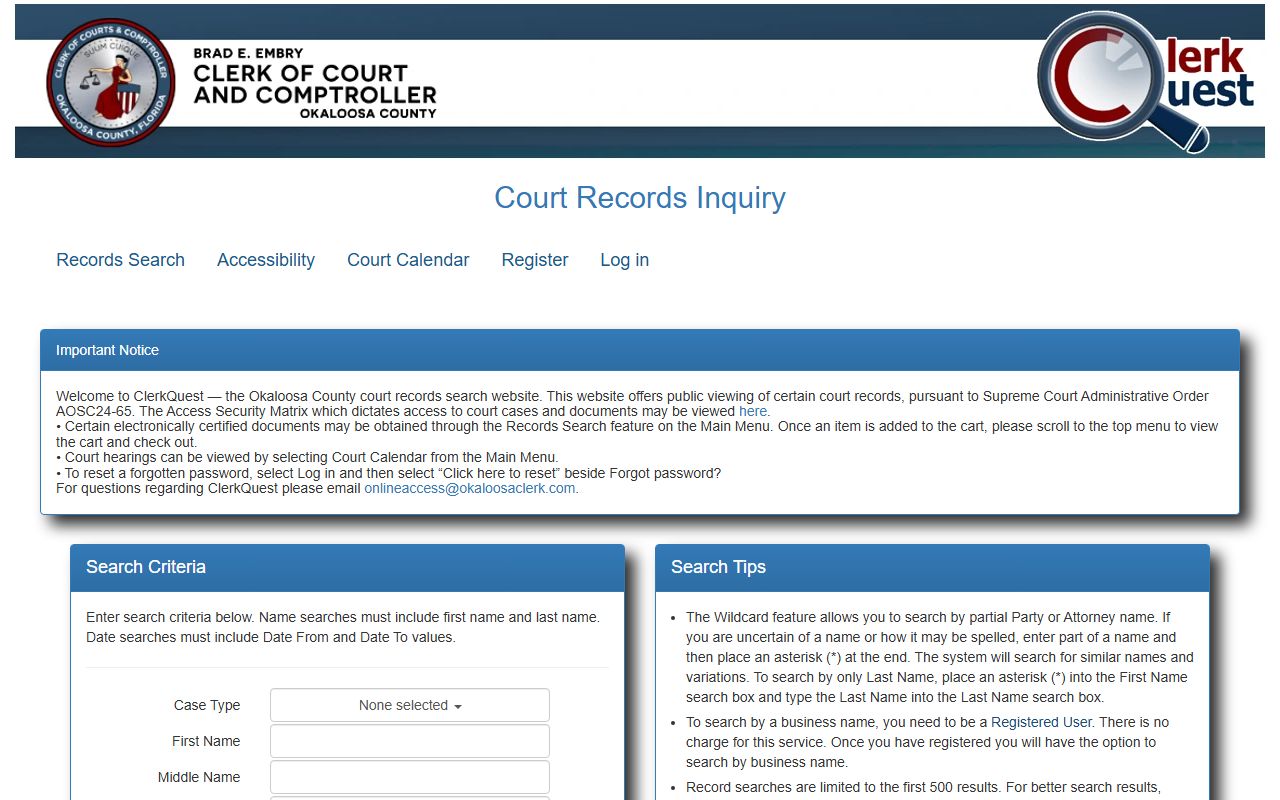
The court case search lives in ClerkQuest, the Okaloosa Clerk's public portal. It offers public viewing of certain court records under a Florida Supreme Court administrative order and an access matrix that controls what each user can see. Arrest and booking detail stays on the jail roster, while the charges, court dates, and dispositions live in the case file here.
- Open ClerkQuest and choose a name or case-number search.
- For a name search, enter both a first and last name, since the portal requires both.
- Open the matching criminal case and read the charge list and docket entries.
- Check each charge's code, level, and current status, plus any bond orders and hearing dates.
Name searches must include a first and last name, date searches need both a from and to date, results are capped at 500, and a business-name search requires a free registered account. Online dockets reach back to about 1990 and document images to about 2009, and a Cloudflare check may appear before a search runs.
The ClerkQuest search screen lays out these fields and notices before you begin.
For copies that are not available online, the Clerk also offers a court-records request form that takes several work days to process.
How Charges Get Filed After an Arrest
Booking happens at the jail, but the court charge record begins only when the prosecutor files a charging document. In Florida that document is usually an information for felonies and many misdemeanors, a complaint at the earliest stage, or an indictment returned by a grand jury for the most serious felonies. Each one opens the case that the clerk then tracks.
| Complaint | Information | Indictment | |
|---|---|---|---|
| Filed By | Officer / Prosecutor | State Attorney | Grand Jury |
| Common For | Early-stage charges | Most felonies and misdemeanors | Serious felonies |
| Starts | The case | The case | The case |
Charge Status and What It Means
Charges shift as a case moves. The prosecutor may file, amend, reduce, add, or drop charges after reviewing the arrest, so the booking charges on the jail roster can differ from the charges in the court file. Reading the status of each charge is what tells you where the case actually stands.
| Status | What It Means |
|---|---|
| Pending | The charge is filed but not yet resolved. |
| Amended / Reduced | The filed charge changed from the original arrest charge. |
| Dismissed | The court ended the charge without a conviction. |
| Nolle Prosequi | The prosecutor chose not to pursue the charge. |
Note: A booking charge is an accusation at intake, while the filed charge is the prosecutor's decision, and the two do not always match.
Bond and Release After an Arrest
Bond is set to assure that a defendant returns to court. In Okaloosa County, many cases, especially misdemeanors, allow bond soon after booking, and a warrant arrest often carries a bond set in advance by the issuing judge. At first appearance within 24 hours, the judge reviews the arrest information and must address each charge by bond or no bond. A hold or detainer from another agency can keep a person in custody even after the local bond is posted.
| Bond Type | How It Works |
|---|---|
| Cash Bond | The full amount is paid directly to secure release. |
| Surety Bond | A licensed bondsman posts the bond and may charge a 10 percent fee. |
| PR / Own Recognizance | Release on a written promise to appear, without full cash. |
| No-Bond Hold | No release by bond until a judge or authority allows it. |
Payment methods and after-hours bond steps vary by charge and court order, so call the jail or the Clerk before bringing payment.
Warrants That Lead to an Arrest
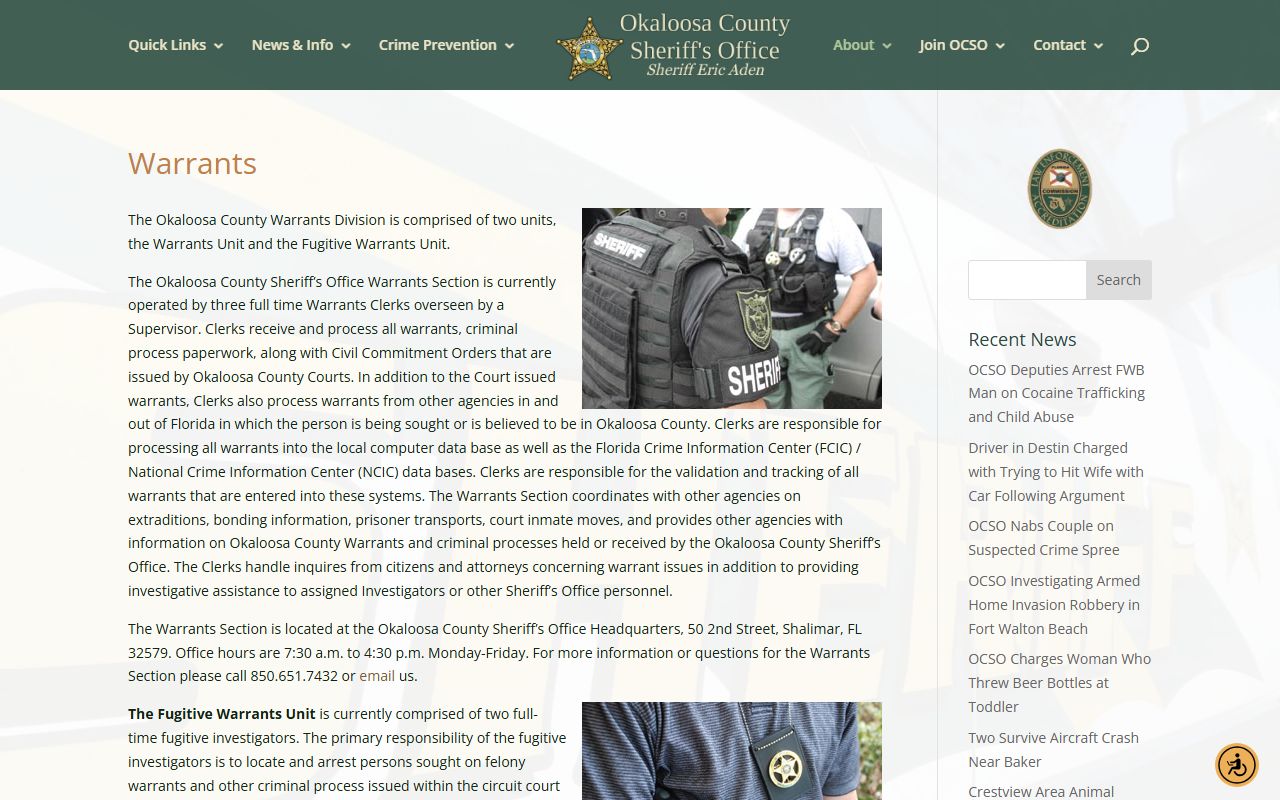
Many bookings start with a warrant or a capias, a court order for arrest often issued after a missed court date. The Okaloosa County Sheriff's Office Warrants Division processes these orders, enters them into state and national databases, validates them, and coordinates extraditions and transports. The official website does not publish a public warrant-search form, but the OCSO mobile app advertises a Warrants feature that lets users check whether someone has a warrant.
The Warrants Division page explains how an order moves from issuance to service.
To confirm a warrant, call OCSO Warrants at 850-651-7432 rather than trusting a scam caller or a third-party warrant site.
Charges vs. Convictions
An arrest and a filed charge are accusations, not findings of guilt. A conviction requires a plea or a verdict, and it rests on a far higher standard of proof. Both stages can appear in public records, so the difference matters when reading a case file.
| Charge | Conviction | |
|---|---|---|
| Stage | Accusation | Verdict or plea |
| Burden of Proof | Probable cause | Beyond a reasonable doubt |
| Public Record | Yes | Yes |
Sealed vs. Expunged Arrest Records
Florida lets some people clear a record after a dismissal or an eligible outcome. Sealing limits public access while keeping the record in existence, and expunction goes further by treating the record as though it never existed. Both run through court order under state law, and eligibility is narrow.
| Sealed | Expunged | |
|---|---|---|
| Visibility | Hidden from public view | Destroyed or treated as never existing |
| Law Enforcement | Limited access remains | Very limited access |
| Eligibility | Fla. Stat. § 943.059 | Fla. Stat. § 943.0585 |
The State Attorney for the First Judicial Circuit
Florida uses the title State Attorney rather than district attorney. Okaloosa County sits in the First Judicial Circuit, which also covers Escambia, Santa Rosa, and Walton counties, and the State Attorney is Ginger Bowden Madden. After an arrest, this office reviews the evidence and decides what formal charges to file or pursue.
That decision is what makes the court record different from the arrest. The prosecutor may file, amend, reduce, add, or drop charges, and the Clerk maintains the case once it is filed. The main office is at 190 W Government St. in Pensacola, reachable at 850-595-4200, and the office publishes Okaloosa-specific press releases and an attorney directory. The court record, not the booking, is where the State's final charging decisions appear.
Requesting Court Documents Not Online
Not every document is available through the online portal. Older files, missing images, and certified copies often require a direct request. The Okaloosa Clerk offers a court-records request form for documents not currently online, which asks for the party name, date of birth, case number, and contact details, and notes that processing may take several work days.
Access level also affects what you can see. ClerkQuest shows redacted document images to the public, and unredacted copies require a courthouse visit with a state-issued ID and proof that the requester is a party to the case. Broader party or attorney access requires registration and, for some roles, a notarized agreement. Knowing which access level you have explains why a case can be visible while a specific document is not.
Background Check Considerations
A casual name search in a court portal is not a background check. Formal background screening for employment, housing, or credit is governed by the Fair Credit Reporting Act and must run through a qualified consumer reporting agency, with notice and consent. Public court records can be read by anyone, but using them to make those decisions carries legal rules a casual lookup does not.
Important: This site is not a consumer reporting agency under the FCRA, and nothing here may be used for employment, tenant, credit, or insurance screening.
Restricted Court Records After an Arrest in Okaloosa County
Not every court record after an arrest is fully public. Juvenile cases, sealed or expunged charges, and active criminal-investigative information are limited under Florida law. The ClerkQuest portal also shows redacted document images only, and unredacted copies require a courthouse visit with a state-issued ID and proof that the requester is a party. Mental-health case results are limited as well, and a lack of search results is not proof that a case does not exist.